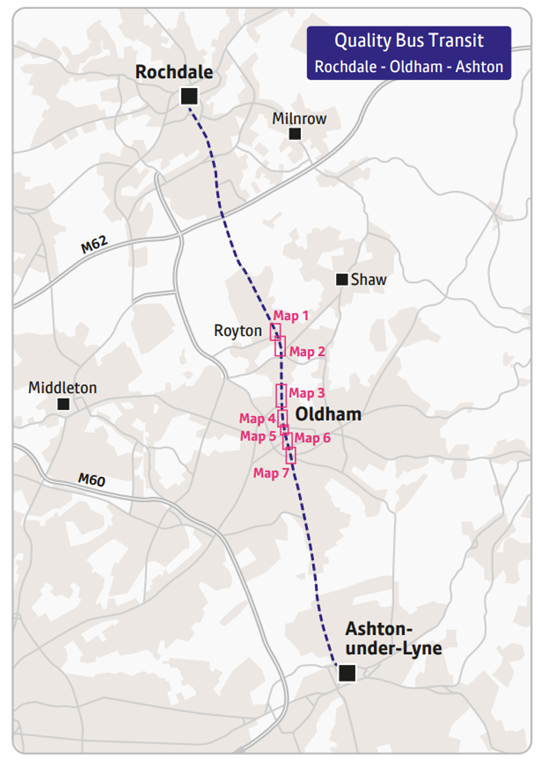
Oldham Council and Transport for Greater Manchester carried out two stages of engagement on the Royton section of the route.
- Outline proposals were shared between 26 February and 24 March 2024.
- Detailed proposals were then consulted on from 17 February to 31 March 2025. This included an online and paper survey, as well as two in-person drop-in sessions.
When completing the survey, people responded to the main survey question: “Please let us know how the specific proposals for Royton would impact you, the journeys you make, or your business or organisation.”
We appreciate people taking the time to feedback on the proposals. We know residents care deeply about Royton town centre and understand the community has a variety of views on different aspects of the project.
A range of views were received during the engagement and consultation. Some respondents supported the key project benefit to improve journeys times along the Rochdale – Royton – Oldham – Ashton route and were in favour of proposed improvements to cycling, walking, wheeling, and public realm facilities around Royton. However, some also expressed concerns about specific aspects of the project and wanted to see changes made to the proposals.
TfGM and Oldham Council reviewed the feedback from the engagement and consultation phases. In response to the most prominent themes in the engagement and consultation feedback, please find a summary of changes that we have made to the proposals, further actions that have been taken, some clarifications regarding perceptions of what work is planned, and responses to some of the feedback and issues raised.
TfGM and Oldham Council have reviewed feedback from the engagement and consultation. Based on what we heard, we have:
- made changes to the proposals
- taken further action
- clarified what work is planned
- responded to key questions and concerns raised
Changes to railings and pedestrian safety
In designing any scheme, safety is always of the utmost importance, including this one. The initial proposals included the removal of all the existing railings in Royton town centre.
Following engagement, consultation, and further discussions with senior stakeholders, the final plans will instead retain the railings in the areas recommended by a coroner after past fatalities.
We’ve also added clear pedestrian priority zones to help keep people safe. At other locations bollards would replace railings and this will be supported by landscaping at the kerbside in Royton town centre, which will create natural barriers between the pavement and the road.
Oldham Council developed the designs to follow the relevant local and national guidance and the designs have been reviewed by independent road safety experts.
Evidence from previous studies has also indicated that removing railings in certain places can encourage motorists to reduce their speed, making the highways safer for people walking, wheeling, and cycling, as well as improving the public environment.
It can also help reduce the risk of cyclists and pedestrians getting caught on the wrong side of a railing next to traffic.
Other areas in Greater Manchester have removed sections of railings as part of wider highway schemes and seen positive change, growth and regeneration.
An example of this was implemented in Pendleton town centre in 2020, which has seen no collisions involving pedestrians in locations where the railings were removed.
Turning right from High Barn Street onto Rochdale Road
Some feedback suggested that people thought vehicles would no longer be able to turn right from High Barn Street onto Rochdale Road.
All vehicles will still be able to turn right from High Barn Street onto Rochdale Road.
However, the dedicated right-turn lane at this junction, which is only used by a small number of vehicles, will be removed. This will make it easier and safer for people to cross the road.
This dedicated lane can be removed due to the small number of vehicles that currently use the lane.
The traffic lights at this junction will also be updated to allow longer green times on each approach. This will help traffic move more smoothly for all road users.
How right-turn traffic from High Barn Street onto Rochdale Road is being managed
Some people were concerned that allowing right turns without a dedicated lane could cause traffic turning right to block the junction.
We have carried out turning counts at this junction (in July 2023 and ongoing since March 2026) which show that numbers are within a range to keep the junction operating effectively.
The highest numbers of right turns are observed in the evening peak. The highest numbers seen in an example week (w/c 20 April 2026) between 16:00 and 19:00 is 16 vehicles in a 15-minute period. That only happened once during that week.
With the upgraded signal equipment at the junction, when unusual volumes of traffic build up, traffic light signal timings can be adjusted to allow traffic to flow more freely through this junction.
How traffic and access will be managed during construction
We anticipate there could be some temporary disruption whilst the construction works take place.
The work will be carefully planned and carried out by Oldham Council and their contractor, Casey Ltd, in phases to keep disruption to a minimum. Casey Ltd, Oldham Highways and Bee Network Bus Operations will be monitoring performance and any issues throughout the works.
Temporary traffic signals can be changed to suit the local conditions as the construction progresses.
Access to the market, shops and library will remain open throughout the works and updates will be shared regularly through Oldham Council’s website and Facebook pages, letters to affected homes and businesses, and posters and information boards in Royton Library and around the town centre.
Oldham Council can be contacted around the specifics of the construction works throughout their duration at connect@oldham.gov.uk.
How traffic and access will be managed during construction
Traffic modelling anticipates improved journey times for both buses and general traffic through Royton town centre once the proposals have been implemented.
This will be made possible through changes to the layout of the junction at Rochdale Road/High Barn St/Oldham Road/Middleton Road. The changes mean that the traffic signals can operate more efficiently, using modern equipment.
Pavements will be wider, and crossings shorter, which means that pedestrians will need less time to cross, using safe crossing speeds as per national guidance for timings at pedestrian crossings.
The modelling predicts that with the scheme introduction, the total delay (for vehicles going in all directions at the junction) will reduce from 22.6 passenger car unit hours to 18.35 passenger car unit hours.
This shows an improvement in journey times for both cars, buses and emergency vehicles. The southbound lane and bus stop layby have been designed to be wide enough so that buses and emergency vehicles will have space to pass buses that are waiting in the southbound bus stop.
New bus stop and how traffic and access will be managed
Although some respondents raised concerns relating to the proposed new bus stop, congestion and access to nearby businesses, other respondents thought moving the central bus stop could be a good idea. The new bus stop location has been chosen to provide better access to the town centre for all bus customers.
The stop is closer to the pedestrian crossing to access the precinct, and nearer the town centre shops, restaurants, town hall and library. It also removes the barrier of crossing Radcliffe Road which can be challenging for some people with disabilities and people using prams and buggies.
Although buses will stop at this location, traffic modelling anticipates overall improved journey times for both bus and general traffic through Royton town centre once the proposals have been implemented.
The southbound lane and bus stop layby have been designed to be wide enough so that buses and emergency vehicles will have space to pass buses that are waiting in the southbound bus stop.
Along the full section from High Barn Street/Middleton Road to Radcliffe street, including at the new bus stop location, all footways will meet the minimum required by Greater Manchester’s Streets for All Design Guide for High Streets.
This guide aims to ensure accessibility for all on Greater Manchester’s streets. The bus stop will not block access to businesses, and the shelter screen will be located at the kerb edge to provide the most footway width possible between the bus stop and business frontages.
Approach to planting and maintaining clear pavements
We have revisited our designs to ensure the pavement is a suitable width for pedestrians. We have included landscaping and new bench seating away from the road for an improved experience of visiting Royton.
Although some respondents had concerns around maintenance, others approved of having more green space. As well as being nice to look at, the planters also include Sustainable Urban Drainage Systems (SUDS).
These will reduce surface water run-off in the local area and reduce flood risk and puddles. The necessity of maintenance has been considered in the design of the planters and the specification of plants, which provide a natural barrier between the highway and the pavement.
Suggestions that better shelters at bus stops would improve bus experiences in the town centre
We have included upgraded bus stops with raised platforms for step free access when boarding the bus and new bus shelters in our design proposals.
Reinforcing our commitment to a fully accessible network and improving your overall journey experience – on and off the bus.
Approach to bus service improvements and highway changes
The layout of junctions and associated traffic congestion is a major factor in the reliability and frequency of bus services and congestion at junctions can cause variability in bus journey times.
The type of junctions a bus passes through directly affects total journey time and reliability. Even if a route is clear between junctions, junctions which aren’t as well designed as they could be can add unpredictable delay, which can lead to late running buses, bus bunching, and gaps in service.
The proposals aim to improve junction performance in Royton at the Rochdale Road/High Barn St/Oldham Road/Middleton Road junction and increase the reliability of bus journeys by making minor changes to the road layout and installing new traffic signal equipment.
They are part of wider proposals for 15km of road between Rochdale, Royton, Oldham, and Ashton which will improve bus journey times at junctions for the 409 and all other services that use this route.
Managing traffic in residential areas during roadworks
The phasing of the construction roadworks is planned to minimise “rat-running” and increased traffic in residential areas.
Casey Ltd, Oldham Highways and Bee Network Bus Operations will be monitoring performance and any issues throughout the works.
This means that temporary traffic signals can be changed to suit the local conditions as the construction progresses.
Approach to cycling provision as part of the proposals
Although some respondents raised concerns relating to the above, other respondents were not in favour of any improvement to cycling infrastructure.
Further cycling infrastructure cannot be part of these proposals because there is not enough width to put appropriate and safe cycle lanes along the section of Rochdale Road between High Barn St/Middleton Road and Radcliffe Street where this project is being implemented.
The shared cycle and pedestrian crossing next to the Town Hall will be reinstated as a cycle and pedestrian facility, shared space to travel east – west across Rochdale Road and cycle parking near the precinct will also be reintroduced.
Views that the proposed widening of the footpath is unnecessary
Although some respondents felt the widening of the footpath was unnecessary, others approved of proposals to widen the footpath.
The footpath is being widened so that it meets Greater Manchester Street for All Design Guide standards for pedestrians, wheelchairs and people with prams to safely use the space.
The widened footpaths also support the ambition to increase the number of people visiting Royton town centre.
Improved road surfaces should be a priority
Improving road surfaces in Oldham remains a priority. However, funding for the Improving Journeys Royton proposals comes from the government’s City Region Sustainable Transport Settlement, which is intended to support enhancement and investment in public and sustainable transport infrastructure.
General road maintenance works, such as repairing potholes, are usually funded through separate budgets. As part of the Royton improvements, maintenance work and resurfacing will be undertaken within the scheme area, reducing the burden on Oldham Council’s highways maintenance budgets.
Approach to improving parking behaviour and road safety
Oldham Council and TfGM are actively exploring complementing the current proposals with a red route proposal through Royton and along the Oldham section of the 409 bus route.
A red route would enable additional enforcement powers and opportunities to address any illegal parking, waiting and loading.
This proposal will be consulted upon by Oldham Council as the Highway Authority, and Traffic Regulation Order adverts will be posted in local press, on lamp columns and on their website.